










































IDEAS (Innovating, Designing, Evaluating and Applying to Small-Scale Projects) Guide and Facilitators' Guide
"...a resource to develop your evaluation plans before you begin a new project, so that during the journey you have a strategy and tools to help you watch and listen to the changing situation around you....Incorporating evaluation and learning into your project journey from the beginning means you will be able to adapt your project to the changing tides, so that you can keep turning your canoe in the direction of your island."
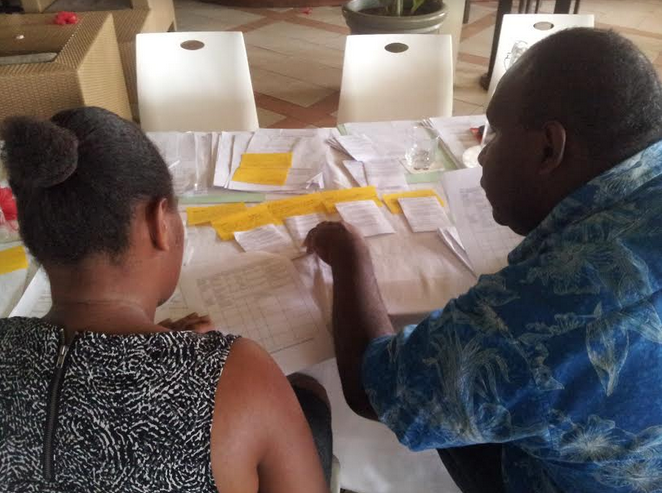
Intended for organisations and people who are undertaking small media and communication for development projects, "IDEAS" refers to Innovating, Designing, Evaluating, and Applying to Small-scale. It describes a process for helping practitioners embarking on a project evaluation to determine the important questions to ask, the different ways to answer questions, and the skills needed to interpret the information. The IDEAS Guide and the Facilitators' Guide are co-created resources, developed by RMIT University researchers with feedback and contributions from media and communication practitioners as part of an action-research initiative, the Pacific Media Assistance Scheme (PACMAS) Innovation Fund programme. The co-creation process included two workshops where the tools were trialled and developed at different stages of the project. The Innovation Fund offers small grants for new and innovative media and communication projects to people and groups located across the Pacific region. PACMAS encourages applications from people and organisations with little or no experience of developing projects as a way to foster grassroots participation and innovation. Innovation funding requires a commitment to capacity development for project teams as well as design and evaluation tools that are realistic for small-scale projects, sensitive to culture, and easy to understand and use. Hence the motivation for IDEAS - most of the examples in which are drawn from projects in the Pacific.
In that context, the IDEAS Guide leads users through the process of designing a project and thinking about the project's evaluation, with a focus on how to do useful evaluation for learning and continual project improvement. It is designed to cater to a range of different skill levels in evaluation. It begins with an introduction to the guide and how it can be used for designing, evaluating, and learning about small-scale communication. Ten modules follow:
- Module 1: Understanding the role of evaluation and learning in innovation
- Module 2: Defining your project goals and priorities
- Module 3: Understanding the people connected to the project (stakeholders)
- Module 4: Stakeholder participation and communication
- Module 5: Doing the right thing by the people involved with the project (ethics)
- Module 6: Planning data-use
- Module 7: Asking the right [evaluation] questions
- Module 8: Planning information and data collection
- Module 9: Making sense of data
- Module 10: Reporting and sharing [data, including non-traditional and visual methods]
Two separate files - Methods Cards and Reporting Cards - accompany the Guide. For example, the former resource features information about "Using participatory photography as a tool for evaluation-based storytelling. Participants use cameras to capture images as a response to topics or questions, then discuss them in a group. Photovoice stories can be made as posters, sticking images to a piece of card with explanations and stories under the photographs. You can also create multimedia stories, which can be embedded in your own website, YouTube or other publishing sites, or sent to the funder and other audiences as a private link. Music, text and narratives to accompany the photograph can be added."
According to the authors, any media and communication practitioner or team undertaking a development or social change project could use the IDEAS Guide. It is designed as an entry-level resource for people with little or no experience of evaluation. It is intended to be used at the beginning of a project to help connect the design of the project with a learning, continual-improvement approach to the evaluation.
The Facilitators' Guide was developed to accompany the IDEAS Guide to help facilitators run workshops to effectively support capacity development for individuals working in grassroots and community organisations who might have little or no experience of evaluation. In the context of a small grant or innovation fund, a facilitator would usually be part of the managing or funding organisation. The facilitator may have a specific role in supporting capacity development, a role in monitoring and evaluation, or any other position with an interest in assisting the recipients of funds to manage their own project design and evaluation.
A PowerPoint file with workshop slides has been created to support facilitators. It is included as a companion file to the IDEAS Facilitators' Guide. If the PowerPoint will be used during the workshop, facilitators are encouraged to adapt it to suit. Guidance on the use of slides is included throughout the Facilitators' Guide.
While they can be used independently, and it is hoped they will be adapted to a range of contexts, the IDEAS Guide and the IDEAS Facilitators' Guide have been developed with the idea that a funding organisation could play an active role in helping project teams to use IDEAS.
Publishers
74 (Guide); 66 (Facilitator's Guide) - with additional materials
BetterEvaluation, February 2 2017; and email from Jessica Noske-Turner to The Communication Initiative on February 12 2017.
- Log in to post comments