










































Citizens' Constitutional Forum (CCF)
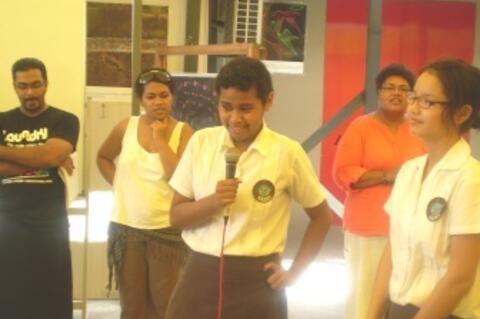
CCF draws on a variety of communication modes and strategies to empower people with knowledge on good governance, human rights, and multiculturalism. The 2-pronged approach centres around the complementary methods of advocacy and education.
CCF's Education Program is committed to promoting peace and multiculturalism where people live in equality and respecting the rule of law. The goal is to empower people in the three target provinces - Tailevu, Naitasiri, and Ra - to acquire knowledge and understanding about democracy, human rights and responsibilities, citizenship, and good governance. Community Education Community-based workshops conducted by CCF's education team educate people on human rights and responsibilities, responsible and active citizenship, and good governance principles. Community Leaders Workshops are designed to educate key people in communities on human rights and good governance so that they can influence others and further educate broader communities in CCF's target areas. NGOs Capacity Building Workshops are designed to educate community-based organisations on human rights, good governance and citizenship, and how they can create social change in their own lives and for members of their organisations and communities.
CCF has made media productions such as the following:
- "The Looting", a 20-minute radio play on events of looting and destruction of property in Muaniweni, Fiji in 2000. The play aims to educate Fijians on real events to prevent further racist acts. This play is available on CD in English, Fijian, and Hindi languages.
- "Dialogue in necessary for change", a newspaper supplement educating people on the necessity and basics of dialogue. The supplement also features a summary of countries where dialogue/peace processes have taken place, website links for information on dialogue processes, and research articles, as well as quick views of the public on dialogue as a way forward for Fiji.
- "Religious Tolerance as a Foundation for Peace", a newspaper supplement educating Fijians on why respect for Freedom on Religion and Belief is essential for peace in the world. The supplement also includes: a summary on human rights conventions and treaties that protect freedom of thought, conscience, religion, and belief; official statistics on countries where violations relating to religious freedom have occurred; and useful websites.
- Tutaka, CCF's Quarterly Newsletter.
- Constitutional Matters Newsletter - Launched in November 2009, this periodical newsletter aims to improve access to justice and enhance the rule of law by keeping the public informed of changes under new decrees, judicial news, and other significant legal developments in Fiji.
CCF's youth programme is designed to create awareness on the roles and rights of young people to become responsible citizens and promote multiculturalism in Fiji's society. Young people from ages 13 to 25 years are engaged through using creative arts and community educational workshops. For example, in 2009 an essay competition was held with the theme: Promoting Multiculturalism in Schools. Students in the 13-14 year age group living in the Naitasiri province, submitted entries; the author of the winning essay and her school each received a prize of US$100. Also, CCF commemorated the International Day of Peace (September 21) 2009 with messages of peace, songs, and lighting of candles. From May 10-14 2010, a CCF Youth Forum will be conducted in Tailevu with the theme of "Young People in Diversity and Dialogue".
CCF's 3-year programme entitled Strengthening Fiji's Democracy was launched in January 2009. It consists of 3 pillars:
- Good Governance, Citizenship, and Human Rights Education - Activities include: a community-based workshop on good governance, citizenship, and human rights; a public lecture series; radio plays on the theme of good governance, human rights, and multiculturalism; production of a human rights documentary; and provision of an advice service to the general public.
- Facilitating a Pathway to Sustainable Democracy - Activities include: Submissions to international institutions, such as the United Nations (UN), on issues related to Fiji; and workshops with NGOs on the way forward for Fiji.
- Countering Racism and Promoting Multiculturalism - Activities include: research on issues related to Fiji's resources and indigenous and minority group rights; a short film on the negative aspects of racism; posters celebrating diversity; and a comprehensive youth programme promoting multiculturalism.
Democracy and Governance.
The seeds of CCF were sown in the aftermath of Fiji's first military coup d'etat in May 1987, which exposed deep divisions in Fiji society. A group of concerned citizens established the "Back to Early May Movement" and called for re-instatement of the pre-coup Government. Several members of the same group were instrumental in organising an informal forum for discussion of constitutional issues. Participants in this forum came from academia, the public service, faith-based organisations, trade unions, and professional associations, as well as other civil society groups. Over a series of meetings in 1991, they agreed to adopt the name, "Citizens' Constitutional Forum". In 1996, CCF was registered under Fiji's Charitable Trusts Act.
From its beginning, CCF received support from a United Kingdom (UK)-based non-government organisation (NGO) called Conciliation Resources (CR). CCF has received donations from many sources; some of its earliest funding came from New Zealand Overseas Development Agency (as it was then) and the Canada Fund. This was later supplemented by funding from the Australian Agency for International Development (AusAid), the European Union (EU), and the United States (US) Department of State. As of April 2010, CCF's donors are the EU, the United Kingdom (UK) Department for International Development (DFID), Misereor, Evangelischer Enwicklungsdiendst (EED), the Finish Embassy in Canberra, and AusAid.
CCF website, April 13 2010.
- Log in to post comments